
85 Seconds to Midnight: Why We Are Closer to Catastrophe Than Ever Before It is official. We are out of time
Analysis of the 2026 Doomsday Clock setting of 85 seconds to midnight. This post connects the January 27th statement on nuclear and biological risks with recent academic research on the Anthropocene and environmental tipping points.
THREATSARTICLE
Myevsmate
1/29/20262 min read
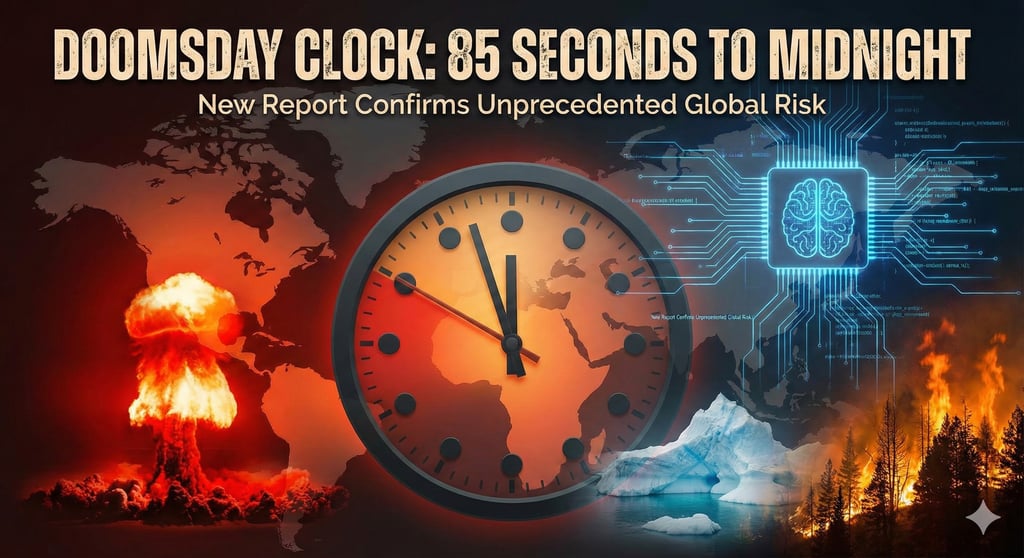
On January 27, 2026, the Bulletin of the Atomic Scientists moved the hands of the Doomsday Clock forward to 85 seconds to midnight—the closest humanity has ever been to global catastrophe.
Just one year ago, the clock stood at 89 seconds. The loss of those four critical seconds is not just symbolic; it is a direct consequence of a world where nuclear risks are escalating, climate action is stalling, and disruptive technologies like AI and "mirror life" are outpacing our ability to govern them.
But to truly understand what this signal means, we must look beyond the headlines. We need to understand the scientific and systemic frameworks that track our slide toward the precipice.
Understanding the Warning Systems of the Anthropocene
In a recent article, "Doomsday Clocks in the Anthropocene Era: Understanding Existential Risks To Humanity," published in Anthropocene Science, explored exactly how these warning mechanisms work and why they are essential for our survival.
While the Bulletin of the Atomic Scientists (BAS) focuses on immediate existential threats like nuclear war and AI, another critical gauge—the Asahi Glass Foundation’s Environmental Doomsday Clock—tracks the long-term degradation of our biosphere.
In full analysis, break down:
The Tale of Two Clocks: How the BAS clock (now at 85 seconds) compares to the Environmental Doomsday Clock (set at 9:33 in late 2025), and why we need both to see the full picture.
The "Anthropocene" Context: Why these clocks are not just about politics, but are defining markers of a geological epoch where human activity is the primary driver of planetary change.
The Convergence of Risks: How distinct threats—from the "Golden Dome" missile defense systems to the synthesis of "mirror life"—are intertwining to accelerate our path to destruction.
Why Read the Full Article Now?
The move to 85 seconds confirms the dangerous trends identified in my research. The Bulletin has cited the collapse of global agreements, the rise of autocracy, and the "normalization" of nuclear risk as key drivers for this year's setting.
The paper provides the analytical framework to understand why this is happening. It moves beyond the fear of the ticking clock to offer a comprehensive look at the methodologies, the history, and the urgent governance innovations required to turn back time.
As the Bulletin states, "The doorstep of doom is no place to loiter". We must understand the risks to mitigate them.
https://link.springer.com/article/10.1007/s44177-025-00104-z
Connect
Join our community of environmental enthusiasts today.
© 2025. All rights reserved.